
The book, by Manu Gupta
Road to Success: 5 Game Changing EPC Strategies
A book for owners and contractors who have watched a project slip on cost or time and want to know where it went wrong. Written by Manu Gupta, founder and director of a roll-forming and PEB plant at Bhiwadi that has supplied airports, metro corridors and factories.
A short summary of each of the five strategies is below, free to read.
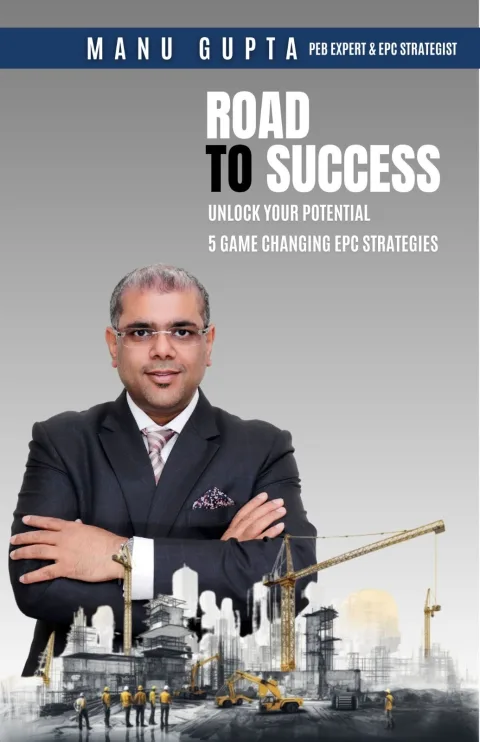
The book
Road to Success: 5 Game Changing EPC Strategies, by Manu Gupta, founder and director of MNF Metals & Forming. It covers the five things that most often push an EPC project over budget or past its date: cost, schedule, supply, quality and risk. Each gets a chapter with what goes wrong, what to do about it, and five Indian projects that handled it well, among them the Delhi Metro, the Dedicated Freight Corridor and the Mumbai Trans Harbour Link.
Manu wrote it from more than two decades in the PEB and EPC trade, most of it as a supplier to PEB builders and EPC companies.
Who it is for
Mainly procurement heads and managers at EPC companies and large PEB builders, the people who choose the vendors, sign the purchase orders and answer for the material when it is late. It is just as useful to owners building their first or their fifth factory, and to EPC project heads who carry the penalty clause. Consultants and PMCs who have to explain to a client why the roof is late. Purchase managers choosing between three quotes that look the same on paper.
For the technical side, sheet thickness, roof pitch, PEB frames, our guides cover that separately.
What EPC projects get wrong
In our experience an EPC project rarely fails at the tender. It fails months in, when a vendor stops supplying, as it did on a bottling plant at Kosi and on the Delhi to Meerut NCRTC stations, or when the design changes at the last minute, as at Lenskart in Bhiwadi, or when a penalty clause hangs over every day of delay, as at Ayodhya Airport. The full accounts are on the projects pages.
The five strategies
A short summary of each strategy, one per chapter. There is no email gate and there will not be one.
1. Cost overruns and budget management
Most overruns start with an estimate built on a vague scope. Define the scope in detail first, because that is the baseline every rupee is measured against. Build a first estimate from past jobs, then check it with a proper quantity take-off at current labour rates, material prices and equipment hire, and keep a contingency reserve for the risks you have listed. After that, costs are held by buying well (steady suppliers, bulk orders, value engineering on the design), by matching labour and equipment to the milestones, and by tracking spend as it happens rather than at month end.
2. Project schedule delays
Break the job into a detailed work breakdown structure and find the critical path, the chain of tasks that sets the finish date. Watch that chain, not everything at once. Put buffer time into the plan, level labour and equipment so nothing sits idle while something else waits, and get the client, contractors, suppliers and authorities talking on a fixed reporting rhythm. Contracts should carry dates and milestones that can actually be met, and scheduling software, BIM clash checks and live progress tracking catch slippage while it can still be recovered.
3. Supply chain disruption
A project that depends on one vendor for a critical item is one phone call away from stopping. Qualify more than one supplier for every critical material, and check each on reliability, quality, financial health and track record before the order, not after. Keep safety stock of the items that would halt the site, source locally where you can, and set up dual sourcing for the rest. Map the supply chain to see where a single failure would hurt most, have the fallback source agreed in advance, and track material in transit so a delay is known the day it happens.
4. Ensuring quality
Quality is cheapest when it is written into the purchase order. Choose suppliers and contractors on their track record and quality systems, audit them, and put the standards, inspection criteria and test methods into the contract so there is no argument on site. Inspect regularly, train the site team, and bring the client and consultants into quality planning at the start rather than at handover. Share the quality figures openly and record what each project teaches, so the next one starts ahead.
5. Risk management and mitigation
List the risks early (technical, environmental, financial and regulatory) with people from each discipline in the room, then rank them by how likely they are and how much they would cost. For each one decide whether to avoid it, transfer it through insurance, warranties or contract terms, or reduce it. Keep a contingency plan and a reserve for what is left. Then keep watching: a risk register, trigger points and clear escalation rules mean a problem reaches the person who can decide while there is still time to act on it.
Two further chapters cover technology on site (automation, IoT and cloud tools for tracking work) and financial planning for a project, from budgeting and cost-benefit analysis to managing financial risk.
Publication details
Self-published by Manu Gupta and first printed in India in 2024. ISBN 978-93-340-3030-3. It is not sold online yet. For a copy, or several for a project team at a discount on quantity, write to us and say how many.
Questions about the book
Where can I buy the book?
It is not sold online yet. Write to us through the form for a copy. For several copies for a project team, there is a discount on quantity.
Is the book about MNF products?
No. It is about how EPC projects are planned, contracted and run, and what goes wrong between the tender and the handover. The strategies apply whoever the supplier is.
Do I have to sign up to read the summaries?
No. The five strategy summaries are on this page for anyone to read, with no email address and no sign-up. There is no gate and there will not be one.