
Purlins · girts · cladding rails
C purlins and Z purlins, rolled and punched to your drawing
Purlins are the light steel sections that run across the rafters of a shed and carry the roof sheets. The same sections fixed to the columns carry the wall cladding, and then they are called girts or cladding rails.
We roll C purlins and Z purlins from 1.0 to 3.0 mm thick, with web depths from 80 to 300 mm, in HR, CR, galvanised, galvalume and POSMAC steel. Holes are punched on the line to your drawing and every piece is cut to length, up to 12 m.
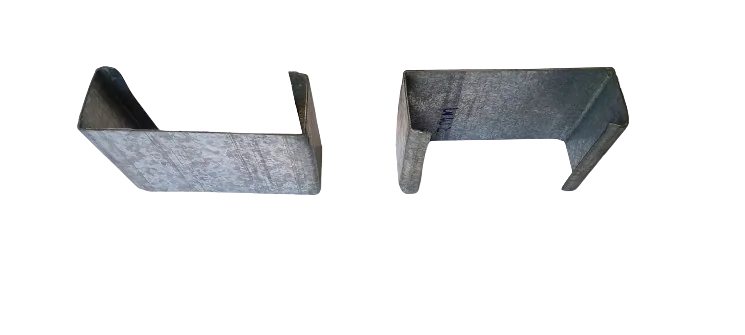
C purlins
1.0 to 3.0 mm, web 80 to 300 mm, flange 40 to 80 mm, lips at 90°. For simple spans, wall girts, cladding rails and mezzanine joists.
Z purlins
1.2 to 3.0 mm, web 100 to 300 mm, flange 40 to 80 mm, lips at 45°. Made to lap over the rafter for continuous runs on longer sheds.
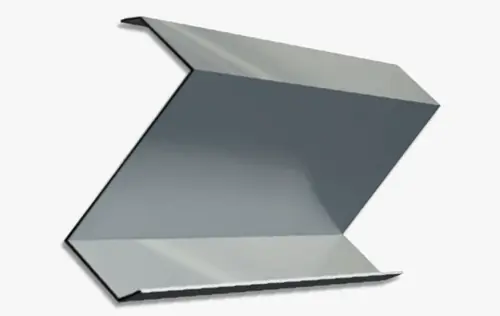
C or Z: which one your shed needs
Older drawings often call them Cee and Zed sections. They are the same thing, and the choice between them comes down to how the purlin sits on the frame.
A C purlin has both flanges facing the same way, so two of them cannot slide into each other. It is the usual choice where each purlin spans from one rafter to the next and stops, and for wall girts, cladding rails and small canopies. C sections can also be bolted back to back to make a stronger member.
A Z purlin has its flanges facing opposite ways. That lets the end of one Z nest inside the next, so they overlap over the rafter and act as one continuous member along the building. On long sheds with many bays this usually lets the engineer use a lighter section than a C doing the same job.
Your structural engineer or PEB designer decides the section, gauge and lap. If you only have the shed size, send that and our drawing office will suggest a layout for the engineer to check.
Materials and steel grades
We roll purlins from five kinds of coil:
- HR (hot rolled mild steel). The heavier gauges, usually painted after fixing.
- CR (cold rolled). A cleaner, more even surface, for work that will be painted.
- Galvanised. Zinc coated, for sheds where the steel stays bare.
- Galvalume. Aluminium-zinc coated, the same family of coating as our roofing sheets.
- POSMAC. A zinc, aluminium and magnesium coated steel from POSCO, for damp or coastal sites.
Steel grades run from 245 to 350 MPa yield. Tell us the grade your design calls for and we will quote on that coil, with the mill test certificate supplied with the consignment.
Punching to drawing
Holes are punched on the line as the section is rolled, so they land where the drawing puts them and nobody drills on the roof. The standard options are:
- two slotted or two round holes in the web at each end, for the cleat bolts
- a round hole in the centre of the web, for sag rods
- round holes in the flange, and punched or slotted holes at any other position you ask for, on purlins, angles and channels
Mark hole sizes and centres on the drawing. If a purlin has no holes, say so, and we will cut it plain.
What to send for a quote
Purlins are priced per kg, so we work out the tonnage from what you send. Either of these is enough to start:
- A drawing or cutting list with the section (C or Z, web, flange and lip), the gauge, the hole positions, the lengths and the quantity of each.
- The shed dimensions (length, width, eave height and bay spacing) if nothing has been designed yet. We will come back with a suggested purlin layout and a budget figure.
Send it by WhatsApp or email, or use the quote form. A photo of a hand sketch with dimensions is fine.
Load tables
We do not publish load tables for our purlins. The section and gauge come from your engineer's design, and we roll to it.
We also do not roll purlins thinner than 1.0 mm or longer than 12 m. Longer runs are lapped or joined over the frame.
Send the purlin drawing or the shed size and we will work out the tonnage and price it.
Get a quoteQuestions buyers ask us
What is the difference between a C purlin and a Z purlin?
The shape of the flanges. A C purlin has both flanges on the same side, so it suits single spans, wall girts and cladding rails. A Z purlin has them on opposite sides, so one Z can lap inside the next over the rafter and the run behaves as one continuous member.
What thickness of purlin do I need?
That depends on the span between frames, the roof load and the wind at your site, so it comes from the engineer's design. We roll C purlins from 1.0 to 3.0 mm and Z purlins from 1.2 to 3.0 mm, and we roll whatever gauge the design specifies within that range.
How long can a purlin be?
Up to 12 m in one piece, which is also the longest length we send by road. Longer runs are lapped (Z purlins) or joined over the frame.
Are purlins sold by length or by weight?
By weight. We price per kg and work out the tonnage from your cutting list or drawing, so two quotes can be compared on the same basis.
Can you punch the holes so nothing is drilled on site?
Yes. Web holes for cleats, centre holes for sag rods and flange holes are punched on the line to your drawing. Each piece is marked so the erection team knows where it goes.