
Roofing and cladding sheets
Colour coated galvalume trapezoidal roofing and cladding sheets, cut to your length
We roll trapezoidal roofing and cladding sheets in three profiles (2 Rib, 3 Rib and 4 Rib standing seam) from colour coated galvalume coil. The 2 Rib and 3 Rib are AZ150 coating, 550 MPa steel, 25 micron paint and 0.5 mm TCT as standard.
Buyers often ask for PPGI. Our standard sheet is galvalume based, which the trade calls PPGL, and we say which one you are getting on every quote. Sheets go out up to 12 m long by road, and the 4 Rib can be rolled on your site in lengths up to 300 m.
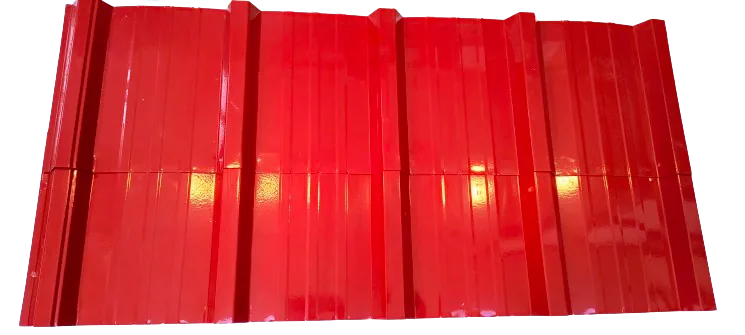
2 Rib profile
Two ribs on a 200 mm pitch, 30 mm crests and 1,000 mm cover. Used mostly for wall cladding and roofs with moderate spans.
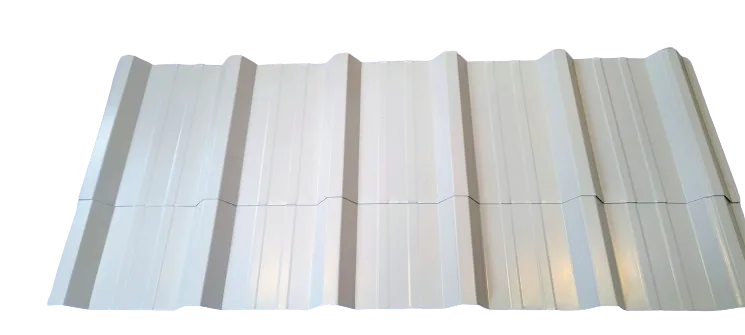
3 Rib profile
Our main roofing sheet. Four 250 mm pitches of three ribs each, domed crests you can walk on, and a minimum roof pitch of 3°.
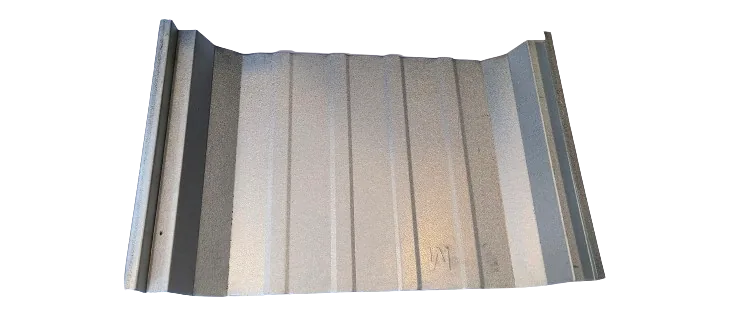
4 Rib standing seam
Rolled on site in single lengths up to 300 m and seamed together with no screws through the sheet. Meant for smaller spans.
The coil and the coating
The 2 Rib and 3 Rib are rolled from galvalume coil: steel with an aluminium-zinc coating of AZ150 to AS 1397, in grade G550 (550 MPa), with a 25 micron top coat in RMP or SMP paint. That is what our specification letters to customers state, and it is what we quote unless your tender asks for something else. The 4 Rib standing seam is rolled from AZ150 galvalume in 300 or 350 MPa steel.
We buy coil from JSW, Tata, AM/NS or POSCO. If a specification names a brand, a colour or a paint system, tell us before we price, because the coil is ordered to suit.
Standard thickness is 0.5 mm TCT (total coated thickness, paint included). That is about 0.45 mm of base metal. Other thicknesses from 0.3 to 0.7 mm TCT are rolled on order, and our thickness guide gives the approximate BMT for each. When you compare quotes, compare the base metal thickness and the coating class as well as the TCT, since two sheets sold as 0.5 mm can carry quite different amounts of steel.
Choosing between the profiles
Four things usually decide it: the purlin spacing, the roof pitch, whether people will walk on the roof, and how long the sheets need to be.
| Specification | 2 Rib | 3 Rib | 4 Rib standing seam |
|---|---|---|---|
| Best for | Wall cladding, and roofs with moderate purlin spacing | Most factory and warehouse roofs | Long roofs with purlins at close centres |
| Rib spacing | 2 ribs per pitch, 200 mm pitch, 5 pitches | 3 ribs per pitch, 250 mm pitch, 4 pitches | Seams at 480 mm, with 4 small ribs at 77 mm in the pan |
| Effective cover | 1,000 mm | 1,000 mm | 480 mm |
| Crest | 30 mm high, 25 mm wide | 30 mm high, 25 mm wide, domed so it can be walked on | Seam 75 mm high: a 55 mm rib and a 20 mm upstand |
| Purlin spacing | Set by our engineers for your site | Set by our engineers for your site | Load chart covers 0.5 m to 1.5 m |
| Thickness, as quoted | 0.5 mm TCT (about 0.45 mm BMT), 0.3 to 0.7 mm TCT on order | 0.5 mm TCT (about 0.45 mm BMT), 0.3 to 0.7 mm TCT on order | 0.5 to 0.8 mm TCT, load chart for 0.5 and 0.6 mm BMT |
| Steel and coating | AZ150 galvalume, 550 MPa, 25 micron paint | AZ150 galvalume, 550 MPa, 25 micron paint | AZ150 galvalume, 300 or 350 MPa, paint set on the quote |
| Minimum roof pitch | 3° | 3° | Made for roofs below 3°, minimum set for each project |
| Side laps | Anti-capillary flute | Anti-capillary flute | Seamed side joints, no end laps |
| Fixing | Self-drilling screws to the purlins | Self-drilling screws through the crest | Concealed clips, no screws through the sheet |
| Longest sheet | 12 m, sent by road | 12 m, sent by road | Up to 300 m, rolled on your site |
TCT is the total coated thickness, paint included. BMT is the steel alone, so 0.5 mm BMT is more steel than 0.5 mm TCT.
- Roof pitch. The 2 Rib and 3 Rib are both rated down to 3°, helped by their anti-capillary side laps. Below 3°, use the 4 Rib standing seam, and we set the minimum pitch for your project. On a long roof with end laps we ask for 5° or more.
- Foot traffic. The 3 Rib has a domed crest designed to take foot traffic during erection and maintenance. On any sheet, walk on the purlin lines.
- Walls. The 2 Rib is the usual choice for wall cladding. Its 200 mm pitch gives a closer rib pattern than the 250 mm of the 3 Rib.
- Long runs and span. The 4 Rib standing seam is rolled on site, so one sheet can run the full length of the roof with no end laps. Its load chart covers purlin spans from 0.5 m to 1.5 m, so it suits closer purlin spacing than a typical shed roof.
Our engineers set the purlin spacing from the wind and load on your site. If you already have a design, send it and we will price the profile it calls for.
Lengths and transport
The 2 Rib and 3 Rib go up to 12 m per sheet, which is the longest length we send by road. Longer roofs are covered with end laps of at least 200 mm, or 150 mm on a roof steeper than 15°. For the 4 Rib standing seam we bring the forming machine to site and roll continuous sheets up to 300 m, which removes end laps altogether.
Sheets are cut to the lengths on your cutting list, so there is little or no cutting on site.
What comes with every dispatch
Each consignment leaves the plant with the mill test certificate for the coil it was rolled from and our own inspection report, along with the GST invoice. Keep the mill test certificate with your project records. It is the document that shows the coating class and steel grade you paid for.
Accessories that match
Flashings and gutters are made to match the sheet in colour and profile. We make eave gutters, box and valley gutters, profile and plain ridges, gable and corner flashings and drip trims, and supply foam fillers cut to the profile, self-drilling screws and sag rods. FRP sheets for daylight and turbo ventilators with a base plate matched to the roof profile are on the accessories page.
What to send for a quote
Six things let us price a sheet order on the first call:
- the profile (2 Rib, 3 Rib or 4 Rib standing seam), or what the building is for if you are not sure
- the thickness, if your specification names one
- the colour, by name or RAL number, or a sample
- the roof area in square metres, or the sheet lengths and quantities from a cutting list
- the delivery place
- the month you need the material on site
A photo of a hand sketch with the dimensions on it is fine. The minimum order is one sheet, at least one foot (300 mm) long.
Send the roof area or a cutting list, the profile and the colour, and we will price it.
Get a quoteQuestions buyers ask us
Which roofing sheet profile should I use for a factory shed?
The 3 Rib, in most cases. It covers 1,000 mm per sheet, takes foot traffic on its domed crest and is rated down to a 3° roof pitch. The 2 Rib is more common on walls, and the 4 Rib standing seam suits roofs flatter than 3°, roofs with close purlin spacing and very long runs.
Are your sheets PPGI or PPGL?
Our standard sheet is PPGL, meaning the base steel is galvalume (AZ150 aluminium-zinc coating) rather than plain galvanised. Many buyers use PPGI to mean any colour coated sheet, so we write the coating class on the quote to avoid confusion.
What thickness are your roofing sheets?
0.5 mm TCT is standard, rolled from 550 MPa galvalume coil with a 25 micron paint coat. That is about 0.45 mm BMT. Other thicknesses from 0.3 to 0.7 mm TCT are made on order. Ask us for the base metal thickness as well if you are comparing quotes.
What is the width of your roofing sheets?
The 2 Rib and 3 Rib are 1,060 mm wide and cover 1,000 mm once lapped, which is their effective width. Both figures are within plus or minus 5 mm. The 4 Rib standing seam covers 480 mm per sheet, rolled from 610 mm wide coil.
What is the longest sheet you can supply?
12 m for sheets sent by road. For the 4 Rib standing seam we roll on site, so a single sheet can be up to 300 m long.
Do you supply flashings and gutters in the same colour?
Yes. Ridges, gutters, gable and corner flashings and drip trims are made to match your sheets, and we supply the matching foam fillers and screws with the order.