
Standing seam roofing
4 Rib standing seam, rolled on site up to 300 m
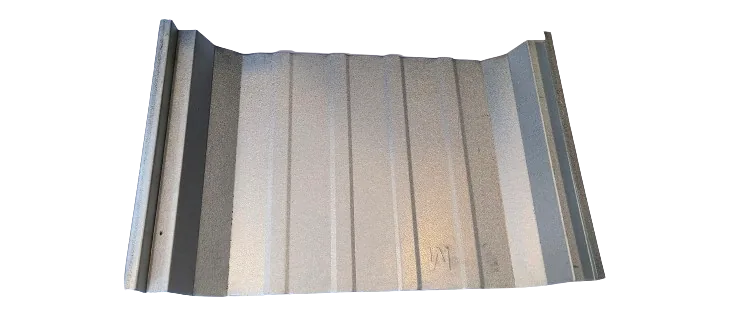
The 4 Rib is a standing seam roof sheet that we roll on your site, in single lengths up to 300 m, and fix by seaming the sheets together instead of screwing through them. A roof slope can be covered with one sheet from ridge to eave, with no end laps and no screw holes in the sheet.
It is meant for smaller purlin spans. The load chart below runs from 0.5 m to 1.5 m, so it is not the sheet for a shed designed around widely spaced purlins.
Where it is used
Low-slope roofs, flatter than the 3° our 2 Rib and 3 Rib are rated to, long roofs where end laps would be a leak risk, and roofs where the owner does not want fasteners through the sheet. The sheets are seamed rather than screwed, so there are no holes in the weather surface for water to find. A wide roof suits it only if the purlins are at close centres. At 1.5 m purlin centres the 3 Rib is usually the better choice.
For Ayodhya Airport we supplied 4 Rib standing seam sheets with matching closures and flashings: a 15-tonne consignment, every piece inspected, supplied in four days. Read the Ayodhya job.
How on-site rolling works
We bring the forming machine and the coil to your site and roll each sheet to the exact length of the roof slope, up to 300 m. The sheets are lifted onto the roof, held to the purlins by concealed clips, and the seams are closed along their length. Nothing has to fit on a truck, which is where the 12 m limit on our other sheets comes from.
You will need to provide space at the site for the machine and the coil, power, a crane, and access to lift the long sheets onto the roof. We will look at the site layout before we confirm the job.
Profile and dimensions
Each sheet covers 480 mm of roof. The flat pan between the seams is 340 mm wide and carries four small stiffening ribs, 2.5 mm high at 77 mm centres, which give the profile its name. At each edge the sheet rises 55 mm to a shoulder, and the seam upstand stands a further 20 mm above that, so the finished seam is 75 mm above the pan.
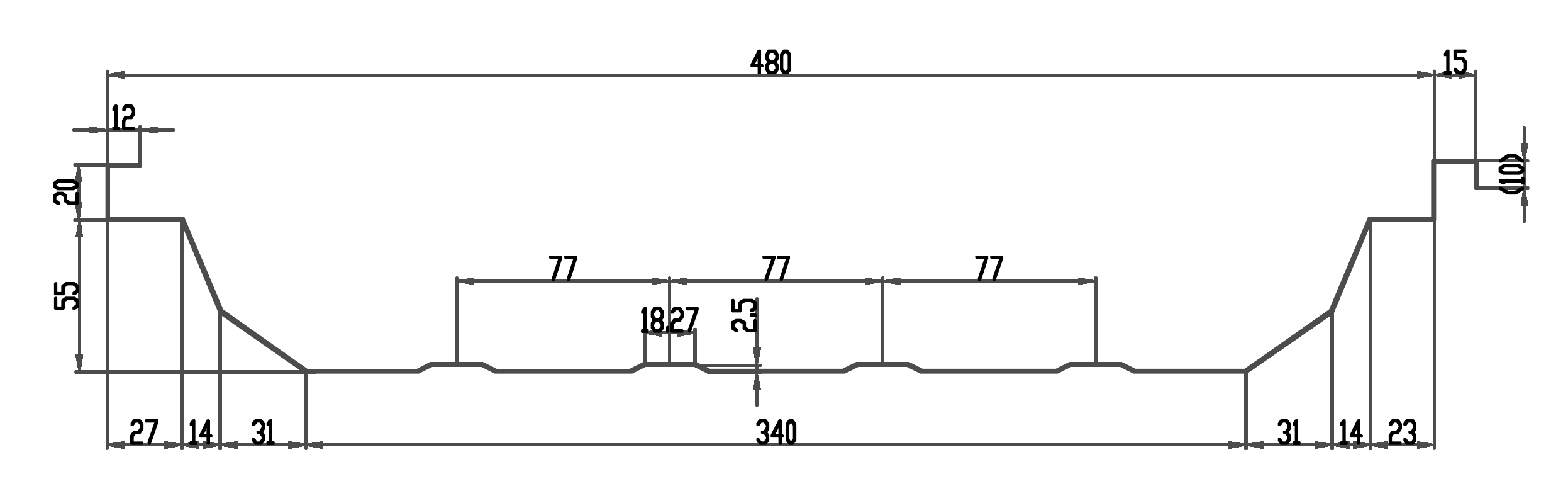
One edge ends in a 12 mm flange and the other in a 15 mm return with a 10 mm lip, which hooks over the flange of the next sheet. The sheet is rolled from 610 mm wide coil.
Allowable loads
These are the allowable loads from our load chart, in kN/m², for each purlin span. Read across from the sheet thickness to the span on your drawing.
| Load case | Purlin span (m) | ||||
|---|---|---|---|---|---|
| 0.50 | 0.75 | 1.00 | 1.25 | 1.50 | |
| 0.5 mm BMT | |||||
| Dead + live | 39 | 21 | 11 | 8 | 4 |
| Wind suction | 28 | 16 | 8 | 5 | 3 |
| 0.6 mm BMT | |||||
| Dead + live | 51 | 28 | 16 | 12 | 7 |
| Wind suction | 28 | 16 | 8 | 5 | 3 |
Test basis: 300 MPa steel, continuous span over a minimum of 3 spans, 5 fasteners per running metre, deflection limited to span/180. BMT is base metal thickness, before coating and paint. The chart starts at 0.5 mm BMT, about 0.55 mm TCT; for a thinner sheet our engineer checks the purlin spacing. Your engineer should check the loads for your site before the roof is designed.
Material
The 4 Rib is rolled from AZ150 galvalume coil, 610 mm wide, in 300 or 350 MPa steel. The load chart is based on 300 MPa steel in 0.5 mm and 0.6 mm base metal thickness. The paint system and colour for the 4 Rib are set on the quote, and the mill test certificate for the coil comes with the job.
Limits
The 4 Rib is for smaller spans. At a 1.5 m span the 0.5 mm sheet is rated for 4 kN/m² dead and live load and 3 kN/m² wind suction, against 39 and 28 at 0.5 m. On-site rolling also needs a site that can take the machine and the lift, so we check that before we quote a date.
Send the roof size and the purlin spacing, and we will tell you whether the 4 Rib suits it and what it costs.
Get a quoteQuestions buyers ask us
Can the 4 Rib go on a roof flatter than 3°?
Yes. It is the sheet we use below 3°, where our 2 Rib and 3 Rib are not rated. The side joints are seamed instead of lapped and screwed, and a sheet runs ridge to eave with no end lap, so there is no screwed lap for water to creep into. We set the minimum pitch for each project, so send the roof drawing with your enquiry.
How long can a 4 Rib standing seam sheet be?
Up to 300 m in one piece. We roll it on your site, so the length is not limited by what fits on a truck.
Are there any screws through the 4 Rib sheet?
No. The sheets are held down by concealed clips on the purlins and the seams are closed between them, so the weather surface has no fastener holes. We mostly use V type clips. A Z type clip costs less and is available on request.
What purlin spacing does the 4 Rib need?
Our load chart covers spans from 0.5 m to 1.5 m. At 1.0 m the 0.5 mm sheet takes 11 kN/m² dead and live load and 8 kN/m² wind suction. For wider spacing we usually suggest the 3 Rib.
What thickness is the 4 Rib?
0.5 to 0.8 mm TCT, as on our profile drawing. The load chart covers 0.5 mm and 0.6 mm base metal thickness, in 300 MPa steel. 0.5 mm BMT is about 0.55 mm TCT, so for a thinner sheet our engineer checks the purlin spacing before we quote.
What is the cover width of the 4 Rib?
480 mm per sheet, rolled from 610 mm wide coil. The seams stand 75 mm above the pan, and the 340 mm pan between them has four small stiffening ribs.
Why roll the sheet on site instead of at the plant?
Sheets sent by road are limited to 12 m, so a longer roof needs end laps. Rolling on site gives one sheet from ridge to eave, which removes the end laps and the leak risk that comes with them.