
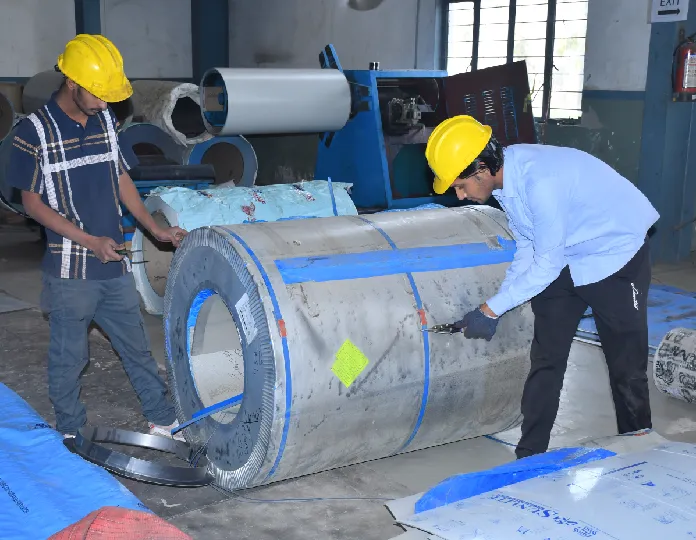
Start with the base metal thickness, then the total
The figure that carries the load is the base metal thickness, written BMT. The figure most quotes show is the total coated thickness, written TCT, which is the steel plus the metallic coating plus the paint on both faces. A quote that only says "0.5 mm" has not told you which one it means.
Our own specification letters give 0.5 mm TCT for the 2 Rib and 3 Rib profiles. The coating and paint on a colour coated galvalume sheet add somewhere around 0.04 to 0.05 mm to the steel, so our 0.5 mm TCT sheet is about 0.45 mm BMT. The table further down gives the approximate BMT for each thickness we roll. The trouble starts when one supplier quotes BMT, another quotes TCT, and the buyer compares the two prices as if they were the same sheet. Ask for both figures on every quote. Ours show TCT as standard, and we give the BMT on request.
Which thickness: 0.4, 0.5, 0.6 or 0.7 mm
For most factory and warehouse roofs in north India, 0.5 mm TCT in a high tensile grade is the right sheet, and it is what we roll as standard. We can go down to 0.3 mm and up to 0.7 mm TCT on order. We do not roll below 0.3 mm, because a thinner sheet dents under a boot and does not hold a screw for long.
As a quick guide, 0.30 to 0.40 mm is for light duty, 0.40 to 0.50 mm for industrial cladding, 0.50 mm for standard PEB roofing, 0.55 to 0.60 mm for heavy duty, and up to 0.70 mm for special applications. The table gives the approximate BMT for each.
| TCT (nominal) | Approx. BMT | Recommended application | Usage category |
|---|---|---|---|
| 0.30 mm | 0.25 to 0.26 mm | Temporary sheds, small shelters | Light duty |
| 0.35 mm | 0.30 to 0.31 mm | Temporary roofing, light cladding | Light duty |
| 0.40 mm | 0.35 to 0.36 mm | Wall cladding, partitions, small sheds | Light to medium |
| 0.45 mm | 0.40 to 0.41 mm | Industrial cladding, light roofing | Medium duty |
| 0.50 mm | 0.45 to 0.46 mm | PEB roofing and cladding, factories, warehouses | Recommended industrial |
| 0.55 mm | 0.50 to 0.51 mm | Heavy-duty industrial roofing, demanding applications | Heavy duty |
| 0.60 mm | 0.55 to 0.56 mm | Heavy roofing and cladding, demanding applications | Heavy duty |
| 0.70 mm | 0.65 to 0.66 mm | Special and heavy-duty applications | Special duty |
The approximate BMT values are indicative only. The actual BMT depends on the metallic coating mass and the paint system, and must be verified from the coil manufacturer's mill test certificate (MTC). Sheet thickness alone does not decide the purlin spacing or whether a sheet is structurally suitable. The profile, steel grade, design loads, support spacing, fasteners and the project's own engineering requirements all count.
What thickness buys you is span. Our 4 Rib standing seam load chart (300 MPa steel, continuous over at least three spans, five fasteners per running metre, deflection limited to span/180) shows the difference. At a purlin spacing of 1.0 m the 0.5 mm sheet carries an allowable dead plus live load of 11 kN/m² and the 0.6 mm sheet carries 16 kN/m². At 1.5 m spacing the figures drop to 4 and 7 kN/m². Going up one gauge lets you open the purlin spacing, and the purlin steel saved can pay for the heavier sheet.
Wind suction is a different matter. On the same chart the suction figures are identical for 0.5 and 0.6 mm at each spacing (8 kN/m² at 1.0 m, 3 kN/m² at 1.5 m), because suction is governed by the fastener pulling through the sheet rather than by the sheet bending. On a windy site, add fasteners and bring the purlins closer before you go up a gauge.
The wind you design for comes from IS 875 (Part 3). It gives India six basic wind speed zones, from 33 to 55 metres per second. Under the 2015 edition, as amended in 2020, Delhi is taken at 50 metres per second. For Bhiwadi and the rest of NCR, read the figure for your exact site off the code's wind speed map rather than assuming Delhi's. Your consultant converts that to a pressure for your roof height and terrain, and the sheet, fasteners and purlins are all sized from it.
A 0.5 mm colour coated sheet weighs about 4.25 kg per square metre.
AZ150 galvalume against 275 GSM galvanised
AZ150 is what we roll for roofing. It means 150 grams of aluminium-zinc alloy coating per square metre, counting both faces, applied to the steel before it is painted, to AS 1397. The alloy is roughly 55% aluminium and 43% zinc with a little silicon. The zinc protects cut edges and scratches, the aluminium forms a stable skin everywhere else, and that is why it outlasts plain zinc in the same air.
275 GSM galvanised means 275 grams of zinc per square metre, both faces, on plain hot dip galvanised steel. Zinc is denser than the alloy, so the two are not far apart in thickness. On the Delhi Metro stations the gutters were 3 mm galvanised steel at 275 GSM because they were welded and stand in water. On a factory shed the gutter material is the customer's choice: colour coated, galvanised, or occasionally hot-rolled steel.
Galvalume and galvanised should not be mixed where water runs from one on to the other, and neither should touch copper or wet cement. And the paint colour tells you nothing about the coating underneath. Two sheets in the same blue can be AZ150 and AZ70, and the second will rust years earlier.
G550 against G350: strength against bendability
G550 is steel with a minimum yield strength of 550 MPa. Our 2 Rib and 3 Rib sheets are rolled from it, and it is what a thin trapezoidal sheet needs to span between purlins without sagging. The trade-off is that it is a full-hard steel that does not like being bent tight, which is why a G550 sheet is never curved to a small radius.
G350 (or G300) has a minimum yield of 350 MPa (or 300). It is softer, so it is the right steel for anything folded, crimped or seamed after rolling: flashings and trims, crimp curved sheets, and standing seam profiles closed on the roof. Our 4 Rib standing seam chart is worked out on 300 MPa steel for this reason, and our purlins are rolled in 245 to 350 MPa grades because they are thicker and take bolts instead of screws.
Paint: RMP, SMP and PVDF
The paint is the layer that fades and chalks first. Three systems are common on Indian coil.
- RMP, regular modified polyester. The base grade and the cheapest. It does the job inside a shed, on wall cladding in shade and on a roof nobody looks at.
- SMP, silicone modified polyester. Silicone in the polyester for better resistance to sunlight, so the colour holds longer on a roof in full sun. This is what we suggest for most roofs in Rajasthan and Haryana.
- PVDF, polyvinylidene fluoride. The premium system, with the best colour retention. For office fronts, showrooms and coastal or chemical air. We roll it on order, on coil painted to order by the coil supplier.
Our specification letters give 25 microns of paint on the weather face, in RMP or SMP. That is the primer and the top coat together. The underside carries a thinner backing coat of 5 to 7 microns, so a sheet must always be laid the right way up. Ask for the paint thickness in microns and the system by name. "Colour coated" on its own could mean any of the three.
What to write in the tender
A specification a supplier cannot dodge looks like this. Change the figures to suit your roof, but keep every line.
Roofing sheet: MNF 3 Rib trapezoidal profile (or equal), 1,000 mm effective cover, 250 mm pitch, 30 mm crest. 0.50 mm TCT, BMT to be stated. High tensile steel, minimum yield 550 MPa. Aluminium-zinc coating AZ150 to AS 1397 and IS 15961. Colour coated, SMP top coat 25 microns nominal, backing coat, colour RAL 7030 or approved. Lengths cut to drawing, maximum 12 m. Each consignment to be delivered with the mill test certificate for the coil used, with coil numbers traceable to the sheets. Coil from JSW or Tata or approved equal.
If the tender leaves out BMT, coating class or the paint system, the lowest bidder wins on a thinner sheet that meets the letter of the tender and fails the roof. We have lost against those bids and then been called back to the same roof a few years later.
How to read a mill test certificate
Every dispatch from our plant goes out with the mill test certificate, the MTC, for the coil the sheets were rolled from. Read it in this order.
- Coil number. Match it to the back print on the underside of the sheet. If they do not match, the certificate is for a different coil.
- Thickness. The mill states the base metal thickness and usually the total. Check it against the figure you ordered.
- Grade and yield strength. The test result for yield should be at or above the grade, so 550 MPa or more for G550. Tensile strength and elongation are listed with it.
- Coating mass. The measured aluminium-zinc or zinc mass in grams per square metre, which should be at or above the class ordered (150 for AZ150, 275 for Z275).
- Paint system, colour and film thickness. On a colour coated coil the MTC or the attached paint certificate names the system and the shade.
- Standard. The specification the coil was made to, such as AS 1397.
Keep the MTC with the building's records. It is the only proof of what was fitted when a warranty claim comes up ten years from now.
Sources and standards referred to
- AS 1397: continuous hot-dip metallic coated steel sheet and strip (coating classes AZ150, Z275; grades G300, G350, G550)
- IS 875 (Part 3):2015, with Amendment No. 2 (2020): design loads for buildings and structures, wind loads
- MNF 2 Rib and 3 Rib specification letters, 2020 and 2022
- MNF 4 Rib standing seam allowable load chart
- MNF roofing and cladding sheet thickness selection guide