
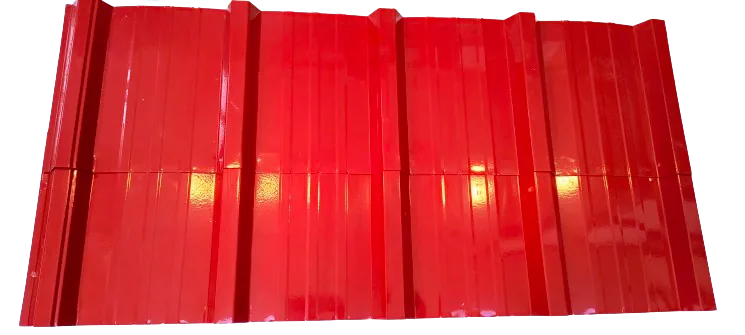
The short answer: 3° for the 2 Rib and 3 Rib, and more if you can
Our 2 Rib and 3 Rib profiles are both rated for a minimum roof pitch of 3°, which is a fall of about 1 in 19. That is the lowest slope at which either sheet, laid with its anti-capillary side laps and fixed on the crests, will shed water without help. That is the minimum. On a long roof, or any roof that must have end laps, we ask for 5° or more. The leak calls we get in July are almost all from roofs laid flatter than that.
Below 3° a trapezoidal sheet with screwed laps is the wrong product. The right one is the 4 Rib standing seam, which we roll on site in continuous lengths up to 300 m and close with a seam instead of a screw, so there are no end laps to leak and no holes through the sheet. We set its minimum pitch for each project.
Which sheet for your roof
Start from two things on your drawing: the roof pitch and the length of the slope from ridge to eave. A long slope here means more than 12 m, the longest sheet we send by road.
| Your roof | Sheet | What to know |
|---|---|---|
| Pitch below 3° | 4 Rib standing seam | The sheet we use on low-slope roofs. We set its minimum pitch for each project. |
| Pitch of 3° or more | 2 Rib or 3 Rib | Suits most factory, warehouse and PEB roofs, once our engineer has checked the purlin design. |
| Long slope, no end laps wanted | 4 Rib standing seam | Rolled on site in one length up to 300 m, so the end laps go. |
| Long slope with end laps | 2 Rib or 3 Rib, at 5° or more | The extra pitch drains the roof faster and keeps water out of the laps. |
If your drawing does not fit one of these rows, send it and we will tell you which sheet we would use.
Why roofs leak at the laps
A metal roof sheet does not leak through the middle. It leaks where two sheets meet, for one physical reason: two flat surfaces a fraction of a millimetre apart pull water into the gap by capillary action, the way a paper towel soaks up a spill. The water climbs the gap against gravity, and on a low pitch it climbs far enough to reach the inside edge and drip.
Wind makes it worse. A gust across a low roof drives water uphill under the lap, and the pressure difference between outside and inside sucks it through any gap. A steeper pitch shortens the time water spends at the lap, keeps the film thin and lets gravity beat capillarity.
Side laps: the anti-capillary flute and the direction you lay
Every side lap on our 2 Rib and 3 Rib sheets has an anti-capillary flute: a small groove rolled into the underlapping rib that breaks the capillary path. Water that climbs into the lap meets the groove, cannot bridge it, and runs back out. This is why both profiles are rated to 3° at all, and why the sheets must be laid the right way round. Wherever practicable, the exposed edge of each side lap faces away from the prevailing wind and wind-driven rain, so the rain is pushed over the lap and not into it, and the flute does its job. In practice that means starting at the leeward end of the roof, the end away from the wind, and working towards the prevailing wind. Where a profile has a fixed male and female rib, an anti-capillary groove or a set laying direction, as our 2 Rib and 3 Rib do, the approved MNF profile drawing and the project specification decide the direction. Lay the sheets the wrong way round and the flute does nothing.
Two more rules. Each side lap is stitched between the purlins with screws at 300 mm centres or closer, so that the lap cannot open under foot traffic or wind. On an exposed or high-wind site the wind-load design may close them up further. And on roofs below 5° we ask for a run of butyl sealant tape in the side lap as well, because at that slope the flute alone is working at its limit.
End laps: where most low-pitch roofs fail
An end lap is where one sheet stops and the next begins along the slope. It is the weakest joint on the roof, because it runs across the water instead of along it. Our sheets go out in lengths up to 12 m by road, so a roof longer than 12 m from ridge to eave has at least one end lap unless it is rolled on site.
A good end lap has four things right. It sits over a purlin, never between two. The upper sheet overlaps the lower by at least 200 mm on roofs up to 15°, and at least 150 mm on steeper roofs. Two runs of butyl tape sit inside it, one near each edge. And the fasteners go through both sheets into the purlin on every crest. The laps are then staggered from one row of sheets to the next, so that four sheet corners never meet at one point, which is a hole no sealant fills.
| Roof slope | Recommended end lap | MNF standard |
|---|---|---|
| Below 5° | Avoid end laps where possible | Prefer continuous-length or standing seam roofing |
| 5° to under 10° | 200 mm minimum | End lap to be properly sealed |
| 10° to 15° | 200 mm minimum | End lap should be located over a supporting purlin |
| Above 15° | 150 mm minimum | Standard minimum end lap |
If your roof needs end laps and the pitch is under 5°, tell us at the drawing stage. We can often move the purlins so the laps land in a better place, or specify standing seam and remove them altogether.
Fasteners on the crests, and how tight
On a roof, screws go through the crest of the rib, never through the valley. The valley is where the water runs, and a hole in it is a leak waiting for its washer to age. On the 3 Rib the crest is domed so the washer seats evenly. Wall cladding is different: there the screw goes in the valley, tight to the girt, because water does not stand on a wall.
The screws are self-drilling, with a bonded EPDM washer under a steel cap. Drive them straight and stop when the washer is just compressed. Over-tightened, the washer squeezes out past the cap, splits in the sun, and the hole leaks within a couple of monsoons. Under-tightened, it never seals. Either way the roof looks fine from the ground for two years. When we audit a roof someone else fixed, crushed washers are the first thing we count.
On a windy site the fastener pattern matters more than the sheet gauge. Our 4 Rib standing seam load chart is worked out with five fasteners per running metre, and the wind suction it allows is the same for 0.5 and 0.6 mm sheet, because the fastener pulling through the sheet governs. At the eaves, the ridge and the corners, where IS 875 (Part 3) puts the highest local suction, the pattern is closed up further.
Sealant: where it belongs and where it is a mistake
Butyl tape inside a lap is a good thing. Silicone smeared along the outside of a lap tells us on an audit that the roof has leaked before. Exposed sealant cracks in Rajasthan sun inside a few years, and while it lasts it traps water in the lap instead of letting it out. If a lap leaks, the fix is to open it, clean it, tape it and refix it.
Sealant also belongs under the ridge and gable flashings and around every penetration for a vent, a pipe or a cable. A roof that was tight at handover and leaks a year later has usually had a penetration cut into it by somebody who did not tell the roofer. Our roof rule book for factory staff has "no unapproved penetrations" as rule one.
Why a long roof needs more pitch
Water from the ridge to the eave adds up. On a 10 m slope the film at the eave is thin. On a 40 m slope four times as much water crosses the last sheet, the laps near the eave sit in a small river during a cloudburst, and the gutter has to take it all at once. A long roof also has more end laps, which is the joint we most want to avoid.
So the rule we work to is simple. Up to 12 m of slope, one sheet, no end lap, 3° is acceptable. Beyond that, either raise the pitch to 5° or more, or move to standing seam and roll the sheet to the full length on site. Where a client wants a low, wide roof for a big warehouse, standing seam, with purlins brought to closer centres, is usually the answer, and we say so in the first conversation.
The monsoon checklist
Do this in May, before the rain, on every metal roof you own.
- Clean the gutters and downpipes. A blocked gutter backs water up under the eave sheet, the one leak no pitch can prevent. Our rule book says gutters are cleaned at least twice a year and always before the monsoon.
- Walk the purlin lines, never the sheet between them, and look at every end lap for gaps, rust lines and old sealant.
- Count crushed or missing washers. Replace any screw whose washer has split, with the next size up.
- Check every penetration: vents, pipes, cables, solar mounts. Anything added since last year needs a proper flashing.
- Look at the ridge and gable flashings for lifted edges.
- Inside, in daylight with the lights off, look up for pinpricks of light, because each one is a hole in the sheet.
- After the first big storm, go up again. Storm damage found in June is a repair. Found in September it is a reroof.
If the roof is more than eight years old, or you are about to put solar on it, get it scored by an audit instead. The inspection guide explains what an audit measures.
Sources and standards referred to
- MNF 2 Rib and 3 Rib specification letters (3° minimum pitch, anti-capillary side laps, 12 m maximum length)
- MNF roof pitch and roofing profile selection guide (minimum pitch by profile, quick selection chart)
- MNF 4 Rib standing seam allowable load chart (five fasteners per running metre)
- MNF end lap length by roof slope standard
- MNF side lap stitching screw spacing guide
- IS 875 (Part 3): wind loads, local pressure coefficients at eaves, ridges and corners
- MNF Roof Rule Book for factory staff and vendors